
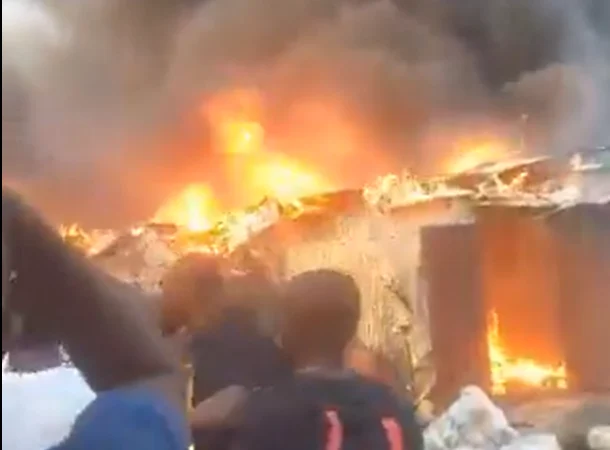
Panic spread through a busy commercial area as a Lagos shop fire destroyed textiles and other goods worth millions of naira, leaving traders counting losses.
The incident, which occurred in a densely populated market cluster, prompted an emergency response from fire service officials and local authorities.
Recurring market fires have remained a major concern in Lagos, particularly in crowded commercial hubs where storage conditions, electrical faults, and limited firefighting access increase risks.
Incidents like the Lagos shop fire often result in significant economic losses for traders, many of whom rely on daily sales for livelihood.
Authorities have repeatedly emphasised the importance of fire safety compliance, including proper wiring, safe storage of flammable materials, and access to emergency exits.
Eyewitnesses said the Lagos shop fire began in the early hours, rapidly spreading across multiple shops due to the concentration of combustible materials, especially textiles.
Thick smoke was seen billowing into the sky as traders and residents attempted to salvage goods before the flames intensified.
Officials from the Lagos State Fire and Rescue Service confirmed that emergency teams were deployed promptly to contain the situation.
Firefighters worked to prevent the blaze from spreading further to adjoining buildings and nearby shops.
A trader affected by the incident described the scale of the loss, stating that several shops stocked with fabrics and clothing materials were completely destroyed.
Another eyewitness noted that efforts by residents to control the fire before the arrival of responders proved insufficient due to the intensity of the flames.
The Lagos shop fire led to the destruction of large quantities of textiles, with traders reporting that entire inventories were wiped out within a short period.
While no fatalities were immediately confirmed, several individuals sustained minor injuries during attempts to rescue goods.
Authorities said preliminary investigations would focus on identifying the cause of the fire, with electrical faults and improper storage among possible factors under review.
The Lagos shop fire underscores the vulnerability of informal and semi-formal market structures to fire outbreaks, especially where safety standards are difficult to enforce.
Economic losses from such incidents often extend beyond individual traders, affecting supply chains, local employment, and access to goods.
For many small business owners, the destruction of stock represents a major financial setback with limited access to insurance or compensation.
Fire incidents also place pressure on emergency services and highlight the need for improved urban planning, fire safety infrastructure, and public awareness campaigns.