
Nigeria’s policy of rehabilitating and reintegrating former insurgents into society is facing renewed criticism, with many citizens insisting that terrorists can’t truly repent after years of violence, killings, kidnappings and destruction inflicted on communities across the country.
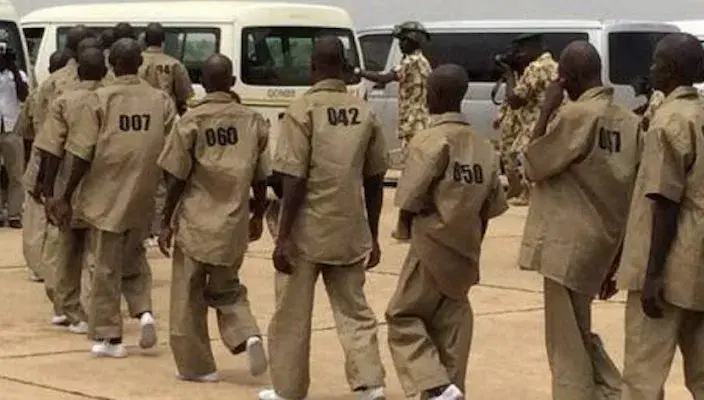
The debate resurfaced following renewed discussions around government-backed deradicalisation and reintegration programmes designed to encourage former members of terrorist groups to abandon violence and return to civilian life. While authorities continue to defend the approach as part of a broader strategy to weaken insurgent movements and encourage defections, many Nigerians remain unconvinced, arguing that the policy risks rewarding individuals who once terrorised innocent citizens.
Across social media platforms and public forums, Nigerians questioned whether individuals involved in terrorist activities should be allowed to return to society without facing full accountability for their actions.
Many argued that communities devastated by years of insurgency are still struggling to recover from attacks that left thousands dead, displaced families from their homes and destroyed livelihoods. For these critics, the idea that terrorists can’t truly repent is not merely an emotional reaction but a reflection of concerns about justice and public safety.
Some citizens pointed out that victims of terrorism often receive far less attention and support than former fighters undergoing rehabilitation programmes. According to them, government efforts should focus first on rebuilding affected communities, supporting widows and orphans, compensating victims and strengthening security before considering reintegration initiatives.
Another major concern raised by critics is the difficulty of determining whether former insurgents have genuinely abandoned extremist beliefs.
Many Nigerians argue that while rehabilitation programmes may provide vocational training, counselling and education, they cannot conclusively prove that an individual no longer poses a security threat. Several commentators noted that insurgent groups often rely on deception and infiltration tactics, making it difficult to distinguish genuine repentance from strategic compliance aimed at securing freedom.
These concerns have fueled public skepticism about whether individuals who once participated in violent campaigns can be safely returned to civilian communities. As a result, the belief that terrorists can’t truly repent continues to resonate strongly among many citizens who have witnessed the impact of terrorism firsthand.
Despite the criticism, government officials maintain that rehabilitation remains an important component of counterterrorism efforts.
Authorities have repeatedly argued that military operations alone cannot completely eliminate insurgency and that non-military approaches are necessary to encourage defections and reduce recruitment into extremist groups. Programmes such as Operation Safe Corridor were established to provide former insurgents with psychological support, civic education, vocational skills and deradicalisation training before their eventual reintegration into society.
Supporters of the initiative argue that successful rehabilitation can weaken terrorist organisations by encouraging members to surrender rather than continue fighting. However, opponents insist that such programmes must be accompanied by transparency, strict monitoring and guarantees that public safety will not be compromised.
For many victims and survivors, the conversation extends beyond security concerns. Families who lost loved ones to terrorist attacks continue to demand justice and accountability, arguing that rehabilitation should not overshadow the suffering endured by affected communities. Some observers believe reconciliation cannot occur without acknowledging the pain of victims and ensuring that those responsible for serious crimes face appropriate legal consequences.
Others argue that forgiveness is ultimately a personal decision that cannot be imposed through government policy. These perspectives have intensified the national debate, with many Nigerians insisting that terrorists can’t truly repent unless there is genuine accountability, remorse and evidence of lasting transformation.
The controversy highlights the difficult balance between security, justice and reconciliation in Nigeria’s fight against terrorism.
While the government sees rehabilitation as a practical tool for reducing violence and encouraging defections, critics continue to question whether such programmes adequately address the concerns of victims and affected communities. As insecurity remains one of the country’s most pressing challenges, the debate is expected to remain a prominent issue in discussions about Nigeria’s long-term security strategy.