
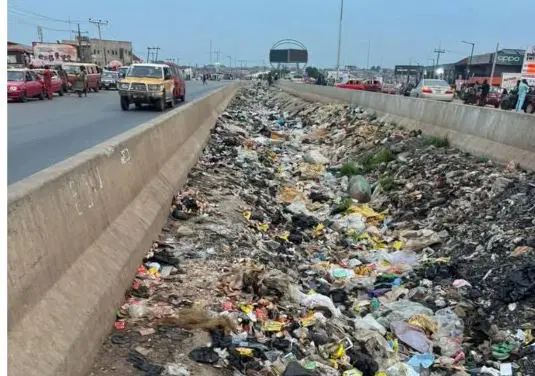
The South-West waste crisis is becoming more visible across Ondo, Oyo, Ekiti and Ogun states, where growing refuse heaps, blocked drainage channels and poor sanitation conditions are raising concerns over public health, environmental safety and government waste management capacity. Residents, environmental experts and government officials say rapid urbanisation, inadequate waste infrastructure, weak enforcement and poor public compliance have combined to worsen the sanitation challenge across many communities.
Akure, the Ondo State capital, remains one of the worst affected cities, with refuse heaps dominating locations including Arakale, Ijoka, Oke Aro, Aule, Orita Obele and Odopetu Market.
Residents complain of persistent foul odours, clogged drainage systems and fears of disease outbreaks. Investigations attribute the situation to inadequate waste evacuation equipment, poor enforcement of environmental regulations and widespread roadside dumping.
Although the state government conducts monthly environmental sanitation exercises through the Ministry of Environment and the Ondo State Waste Management Authority (OSWMA), residents say daily waste generation continues to outpace collection efforts. OSWMA Chairman Olayinka Alabi urged traders to pay approved waste disposal fees, while Commissioner for Environment Dr. Tob Loko reaffirmed the government’s commitment to maintaining a cleaner environment through the “Polluter Pays” policy.
The South-West waste crisis is also evident in Ekiti State, where major dump sites at Ilokun, Shasha and Iyin-Ekiti continue to affect surrounding communities. Residents living near Ilokun described persistent offensive odours and expressed concern over possible health implications, particularly for children.
Former Director-General of the Ekiti State Waste Management Agency, Olasunkanmi Onipede, said government continues to maintain the facilities through improved infrastructure, strategic waste bins and environmental monitoring. He added that authorities currently have no plans to relocate the dump sites but are focused on improving their management.
Across Ibadan, refuse dumps remain common around Bodija, Ojoo, Beere, Challenge, Dugbe, Apata and several other communities despite ongoing government campaigns.
Officials say rapid population growth, financial constraints, illegal dumping and inadequate sanitation facilities continue to frustrate waste management efforts. The Oyo State Ministry of Environment and Natural Resources, alongside the Oyo State Waste Management Authority (OYOWMA), has strengthened enforcement, accredited private waste operators and expanded landfill rehabilitation.
OYOWMA Chairman Abdul-lateef Idowu Oyelere appealed to residents to register with approved waste collectors, warning that illegal dumping continues to undermine government investments. Health experts cautioned that overflowing refuse dumps and open defecation increase the risk of cholera, typhoid, diarrhoea, malaria and flooding during the rainy season.
In Ogun State, authorities continue implementing measures to reduce open defecation and improve refuse collection despite persistent sanitation challenges. The Rural Water Supply and Sanitation Agency (RUWATSAN), working with UNICEF, is expanding its “One House, One Toilet” campaign across several communities. Commissioner for Environment Ola Oresanya said government is constructing 200 public toilets across the state, with about 89 already completed.
The Ogun State Waste Management Authority (OGWAMA) has also intensified enforcement against illegal refuse disposal, arresting offenders and prosecuting violators under existing environmental laws. Government officials say the state is promoting private-sector participation, recycling initiatives and stronger environmental regulations to improve waste management.
Environmental specialists maintain that sustainable sanitation will require stronger investment in waste infrastructure, expanded recycling programmes, consistent public education and stricter enforcement of environmental laws. They also urged residents to patronise approved waste collection services, avoid dumping refuse in drainage channels and maintain proper sanitation practices.
As the South-West waste crisis continues to affect communities across the region, stakeholders say lasting improvements will depend on stronger collaboration between government agencies, private operators and residents to protect public health and preserve the environment.