
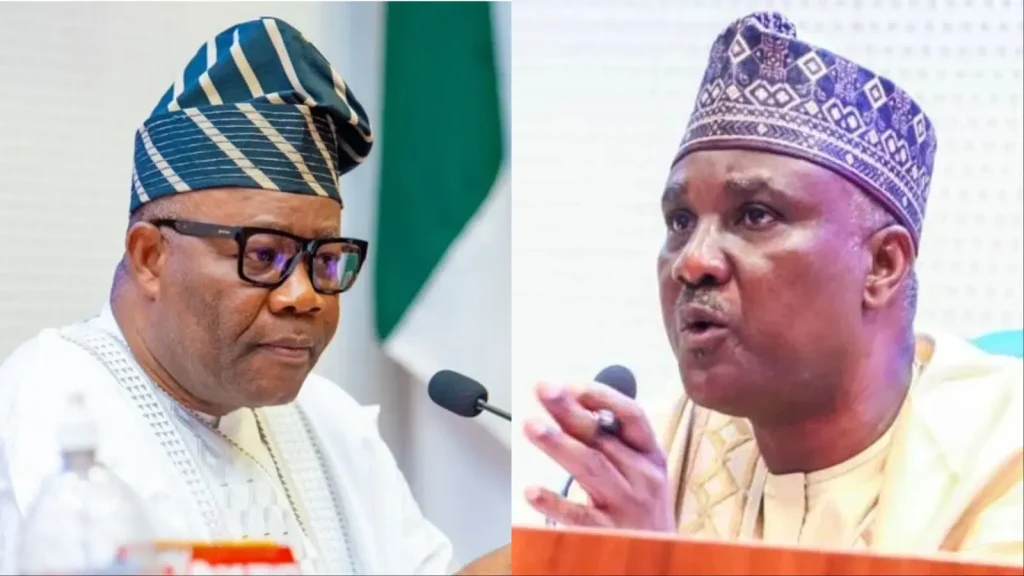
The Socio-Economic Rights and Accountability Project (SERAP) has called on Senate President Godswill Akpabio and Speaker of the House of Representatives Tajudeen Abbas to immediately withdraw the proposed Social Media Shutdown Bill, warning that the legislation poses a serious threat to freedom of expression and other constitutionally protected rights. The organisation described the Nigeria Data Protection (Amendment) Bill, 2026, as an indirect attempt to regulate social media by granting authorities powers capable of excluding digital platforms from operating in Nigeria.
Sponsored by Senator Ned Nwoko (APC, Delta North), the bill seeks to compel social media platforms, data controllers and data processors operating in Nigeria to establish physical offices within the country. It also empowers the Nigeria Data Protection Commission (NDPC) to suspend or prohibit the operations of companies that fail to comply within 30 days.
In a letter dated July 18, 2026, signed by SERAP Deputy Director Kolawole Oluwadare, the organisation argued that forcing technology companies to maintain local offices would expose them to political pressure, increase government influence over online platforms and make censorship demands easier to enforce.
SERAP warned that the Social Media Shutdown Bill would create sweeping regulatory powers capable of removing digital platforms from the Nigerian market, thereby exposing millions of citizens to violations of their rights to freedom of expression, access to information and digital participation.
The organisation noted that similar attempts to regulate social media had previously attracted widespread public criticism and raised significant human rights concerns. It argued that the current proposal revives earlier legislative efforts through corporate localisation requirements rather than direct regulation.
SERAP further warned that if the bill becomes law in its current or substantially similar form, it would immediately institute legal proceedings to challenge its constitutionality and protect Nigerians’ fundamental rights.
According to the group, governments have a legitimate responsibility to regulate digital services, but such regulations must comply with constitutional safeguards and internationally recognised human rights standards. It maintained that any framework governing online platforms should promote transparency, accountability and user protection rather than create new avenues for censorship or political interference.
The organisation also referenced the ECOWAS Court of Justice judgment in SERAP and Others v. Federal Republic of Nigeria, which ruled that Nigeria’s suspension of Twitter violated rights guaranteed under the African Charter on Human and Peoples’ Rights. SERAP argued that although the proposed amendment differs in form, it could produce similar consequences by enabling regulators to prohibit social media platforms from operating in the country.
The letter criticised the proposed powers granted to the NDPC, noting that the bill contains no requirement for judicial authorisation before platforms are prohibited, no obligation to consider less restrictive alternatives and no meaningful safeguards to protect millions of users affected by such decisions.
SERAP argued that the proposed amendment fails the constitutional tests of necessity and proportionality under Section 45 of the Nigerian Constitution. It also stated that there is no evidence existing provisions of the Nigeria Data Protection Act are inadequate or that current enforcement mechanisms have failed.
Beyond concerns over civil liberties, the organisation warned that mandatory localisation requirements would increase compliance costs for startups, technology firms, AI developers, educational institutions and research organisations, potentially discouraging innovation and reducing Nigeria’s attractiveness to investors.
SERAP added that the bill conflicts with the objectives of the Nigeria Startup Act 2022 and the National Digital Economy Policy and Strategy, stressing that no major democratic country requires every social media platform to establish a physical office as a blanket condition for offering services.
The organisation urged the National Assembly to reject and withdraw the proposed legislation, describing it as incompatible with the Nigerian Constitution, the African Charter on Human and Peoples’ Rights and the International Covenant on Civil and Political Rights, while calling on lawmakers to protect Nigeria’s digital economy and democratic freedoms.