

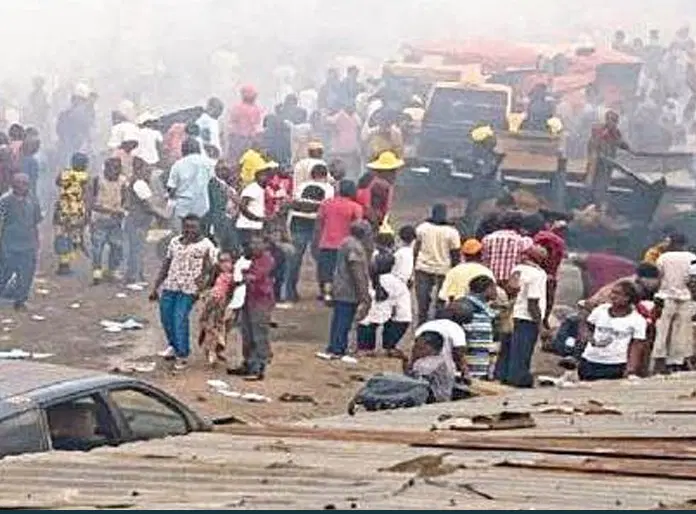
Jilli market airstrike has drawn fresh attention after residents recounted personal losses, including a survivor who said he lost six brothers during the military operation carried out in the North-East, raising concerns over civilian impact in conflict zones.
The airstrike occurred in Jilli, a border community between Borno and Yobe states, an area long affected by insurgency linked to Boko Haram and the Islamic State West Africa Province. Military operations in the region have frequently targeted suspected insurgent enclaves and logistics hubs as part of ongoing counterterrorism efforts. Authorities have maintained that such operations are intelligence-driven and aimed at disrupting militant activities.
However, the presence of civilian populations in or around such locations has continued to raise concerns about the risks associated with aerial bombardments in contested areas. Accounts from survivors have brought renewed focus to the human impact of the Jilli market airstrike, with residents describing significant casualties and destruction.
One resident, identified as Abba, said he lost six of his brothers in the incident.
“I lost six of my brothers in the operation,” he stated, describing the scale of the loss experienced by his family.
Other residents reported that the strike occurred during a market gathering, with traders and visitors present at the time. Military authorities have stated that the operation targeted a known terrorist enclave and logistics base used by insurgents in the area. They described the strike as deliberate and based on intelligence assessments of militant activity.
Government officials have acknowledged that civilians may have been affected, noting that some individuals had travelled to the market despite its status as a high-risk location linked to insurgent operations. Investigations have since been initiated to assess the circumstances surrounding the Jilli market airstrike, including the planning and execution of the operation.
Reports from local authorities indicate that injured victims were evacuated to nearby medical facilities for treatment, while emergency response efforts were activated following the incident.
The Jilli market airstrike highlights ongoing challenges in balancing counterterrorism operations with civilian protection in conflict-affected regions. It underscores concerns about intelligence accuracy, operational risk, and the presence of non-combatants in areas identified as insurgent strongholds.
The incident also reflects broader humanitarian implications, including displacement, loss of livelihoods, and the psychological impact on affected communities.