
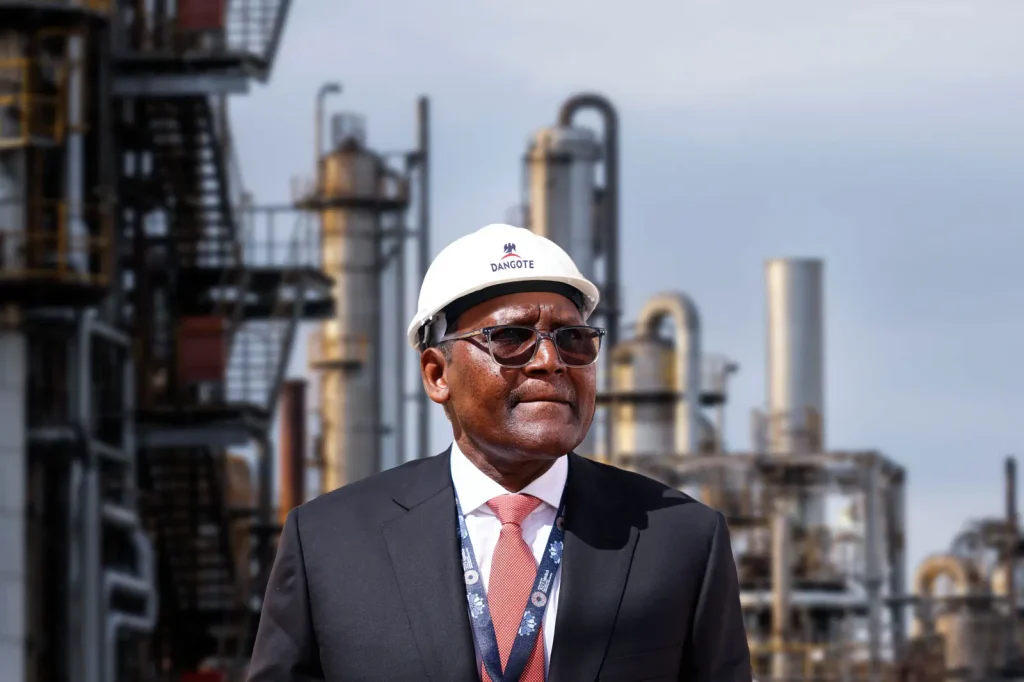
The Dangote Petroleum Refinery and Petrochemicals recorded a profit after tax of about ₦2.55 trillion in the first six months of 2026, marking a significant turnaround in the financial performance of the 700,000-barrel-per-day facility.
The figures were contained in the prospectus for the refinery’s planned Initial Public Offering, IPO. The company recorded approximately ₦19.47 trillion in revenue during the period, based on an exchange rate of ₦1,400 to the dollar. Its earnings before interest, tax, depreciation and amortisation, EBITDA, stood at $2.60 billion, equivalent to about ₦3.64 trillion.
The refinery also recorded a substantial improvement in its operating performance. Average utilisation increased to 83.6 per cent during the first half of the year, compared with about 45 per cent at the beginning of 2026.
The facility reached full crude distillation capacity in the second quarter following improvements to its residual fluid catalytic cracker and a shift away from lower-value reduced crude oil production. Its gross refining margin consequently strengthened to $24.50 per barrel, compared with $13.70 in 2025 and $10.70 in 2024.
The stronger financial performance comes ahead of the refinery’s planned IPO, through which it seeks to raise about ₦2.26 trillion. The offering is expected to comprise 4.1 billion ordinary shares at ₦525 per share and is scheduled to run from September 14 to October 13.
The offer is being positioned as a “people’s IPO”, with Nigerians, Africans and members of the diaspora expected to have an opportunity to acquire shares in the refinery.
Chief Executive Officer of Dangote Refinery, David Bird, said the improved operating performance had strengthened the company’s financing outlook for its expansion programme. He said the facility was now operating at its full 700,000-barrel-per-day capacity, describing the improvement as a fundamental change to the funding basis of the company’s Vision 2030 plans.
The company plans to invest approximately $14.3 billion to double its processing capacity to 1.4 million barrels per day by 2029. The expansion is expected to include additional refining and petrochemical units, which Bird said would enable the facility to produce different specifications of diesel and further deepen import substitution.
Meanwhile, the refinery has continued expanding its international market. It exported jet fuel to the United States for the first time this year and was identified by S&P Global Energy as the world’s largest single exporter of jet fuel during April and May.
Bird said global fuel markets could remain tight as damaged refineries recover and countries rebuild inventories following supply disruptions linked to the Middle East conflict. According to him, deferred maintenance and refinery damage have added pressure to global supply as producers work to meet existing demand and replenish depleted inventories.
Dangote Petroleum Refinery currently has a crude distillation capacity of 700,000 barrels per day and an expansion pathway to 1.4 million barrels per day. It produces Euro V-standard PMS, AGO and Jet A-1, alongside petrochemical products.
Built at an estimated cost of $20 billion, the Dangote Refinery commenced operations in 2024 and has since emerged as a major supplier of refined petroleum products to Nigeria and international markets.