
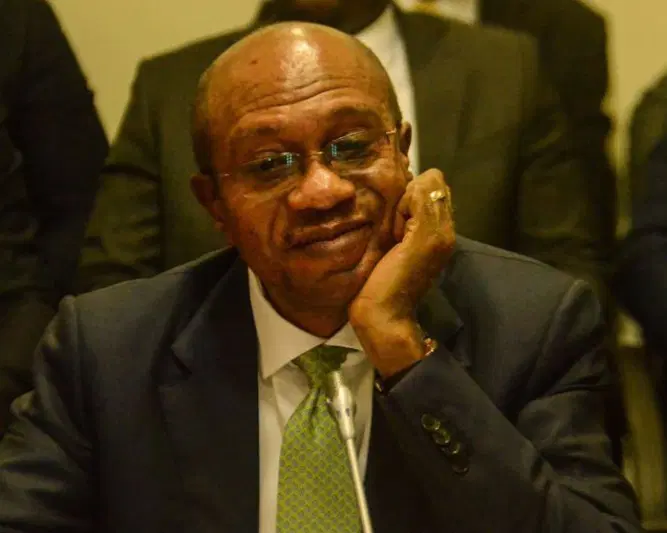
The Special Offences Court sitting in Ikeja, Lagos, has reserved ruling until July 9, 2026, on the admissibility of extra-judicial statements allegedly made by former Central Bank of Nigeria (CBN) Governor, Godwin Emefiele, in his ongoing alleged $4.5 billion fraud case. Justice Rahman Oshodi fixed the date after hearing extensive arguments from both the prosecution and defence over whether the statements the Economic and Financial Crimes Commission (EFCC) seeks to tender were made voluntarily.
The Emefiele fraud trial centres on a 19-count charge bordering on alleged gratification and corrupt demands during Emefiele’s tenure as CBN governor.
His co-defendant, Henry Omoile, is separately facing a three-count charge relating to the alleged unlawful acceptance of gifts by an agent. Both defendants have pleaded not guilty to the charges. At Friday’s proceedings, Emefiele’s lead counsel, Mr. Olalekan Ojo (SAN), urged the court to reject the extra-judicial statements, arguing they were obtained under coercive circumstances.
According to the defence, Emefiele was subjected to physical and psychological torture during his detention by the Department of State Services (DSS), where he was allegedly held for more than 157 days. Ojo relied on provisions of the Anti-Torture Act, 2017, and the Evidence Act, maintaining that statements obtained through oppression cannot be admitted as evidence. He argued that the central issue before the court was whether the statements were voluntarily made.
The defence further submitted that video recordings of the interrogation sessions remain the most reliable way of proving compliance with due process whenever the voluntariness of a statement is challenged. Ojo argued that the prosecution failed to produce such recordings, creating doubts about the credibility of the statements.
He also questioned the absence of independent evidence supporting the statements and challenged the role played by the legal practitioner said to have witnessed the interviews. The defence urged the court to resolve every doubt in favour of the defendant and reject the disputed statements.
Responding on behalf of the prosecution, the Director of Public Prosecutions of the Federation, Mr. Rotimi Oyedepo (SAN), alongside Bilikisu Buhari and C.C. Okezie, presented the EFCC’s eighth witness, investigator Alvan Gurumnaan. The witness told the court that Emefiele was invited for questioning and that all interviews were conducted in the presence of his lawyer. He also informed the court that the prosecution had voluntarily withdrawn one statement dated October 26, 2023.
However, the EFCC requested the court to admit other statements allegedly made on October 27, October 30, November 1 and November 2, 2023. Addressing the withdrawn statement, the witness said:
“If the defence does not want that statement, we are prepared to withdraw it. We are withdrawing it not because it was obtained through torture or oppression.” Oyedepo argued that the disputed statements did not amount to confessional statements and therefore did not require a trial-within-trial.
He maintained that nothing contained in the statements constituted an admission of the offences before the court. The prosecution also argued that the Anti-Torture Act does not make a trial-within-trial mandatory under the circumstances and urged the court to dismiss the defence’s objections and proceed with the substantive hearing.
During the proceedings, counsel to the second defendant, Mr. Adeyinka Kotoye (SAN), informed the court that he had filed an application seeking leave to appeal an earlier ruling. The prosecution did not oppose the request. Justice Oshodi subsequently granted the application.
“I hereby grant the second defendant leave to appeal the ruling of the court,” the judge ruled.
Following arguments from both parties, Justice Oshodi adjourned the Emefiele fraud trial until July 9, 2026, when the court will determine whether the disputed extra-judicial statements will be admitted into evidence. The judge also scheduled October 6, 7 and 8, as well as November 11, 12 and 13, 2026, for the continuation of the substantive trial after the ruling on the admissibility issue.