
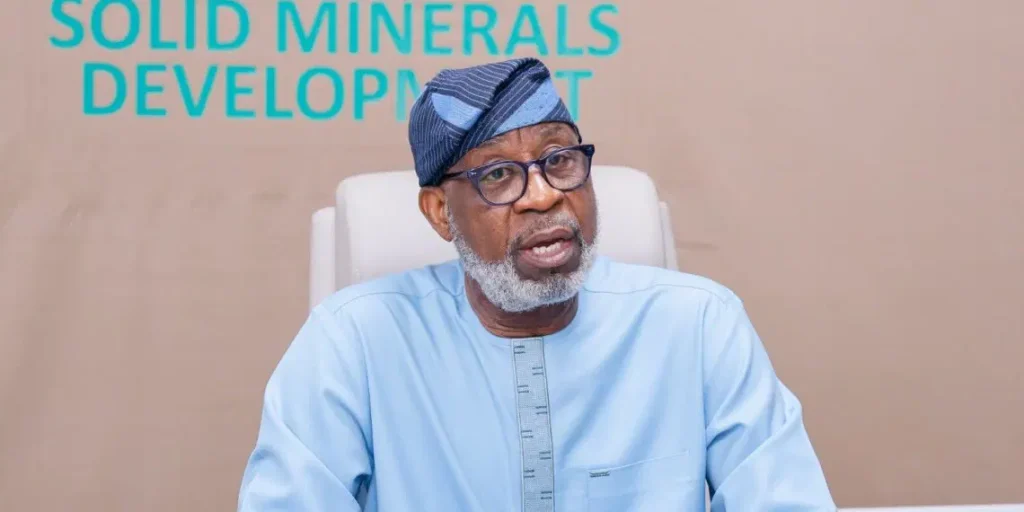
The Federal Government has disclosed that it attracted over $2.6 billion in foreign direct investment (FDI) into Nigeria’s solid minerals sector within two years under the current administration.
The Minister of Solid Minerals Development, Dele Alake, made the disclosure at the Powering Africa Summit in Washington, D.C., United States.
He spoke during a panel session focused on Africa’s role in meeting global demand for critical minerals.
The investment inflow comes amid ongoing reforms introduced by the Federal Government to reposition the mining sector as part of efforts to diversify the economy.
Alake stated that the administration of Bola Ahmed Tinubu has implemented measures aimed at improving governance, strengthening regulation and enhancing investor confidence in the sector.
According to him:
“Within the last two and a half years, we have successfully de-risked and sanitized the sector, attracting over $2.6 billion in FDI.”
He explained that reforms include the digitisation of licensing processes, improved regulatory frameworks and secure mineral tenure systems, which provide long-term stability for investors.
The minister also noted that incentives have been introduced to attract investors. These include tax waivers on imported mining equipment and the full repatriation of profits after payment of royalties and taxes.
On enforcement, Alake said the government established Mining Marshals to tackle illegal mining activities across the country.
He disclosed that more than 350 suspected illegal miners, including foreign nationals, have been arrested, with over 150 currently undergoing prosecution.
He stated that the measures were introduced to strengthen confidence in the sector and ensure compliance with regulatory standards.
Alake also advocated for the creation of regional industrial corridors across Africa to support mining development.
He cited examples such as the Lagos–Abidjan corridor, which spans Nigeria, Benin, Togo, Ghana and Côte d’Ivoire, as well as the Walvis Bay Corridor linking Southern and Central Africa.
He said such corridors would support infrastructure development, energy access, technology transfer and cross-border industrialisation.
The panel session featured representatives from international institutions and private sector organisations, including the U.S. Export-Import Bank, ReElement Technologies Africa, TechMet and McDermott Will & Schulte.
Participants emphasised the importance of collaboration, private sector investment and sustainable partnerships in developing Africa’s mining sector.
The reported inflow of $2.6 billion reflects increased investor interest in Nigeria’s solid minerals sector following regulatory and policy reforms.
The sector is positioned as a key component of the country’s economic diversification strategy.