
The Federal Government has inaugurated a high-purity gold refining plant in Lagos and announced that a $600 million lithium processing facility in Nasarawa State is ready for commissioning, officials say.
The projects signal progress under the government’s value-addition policy aimed at strengthening Nigeria’s mineral processing capacity and positioning the country as a key player in global critical minerals supply chains.
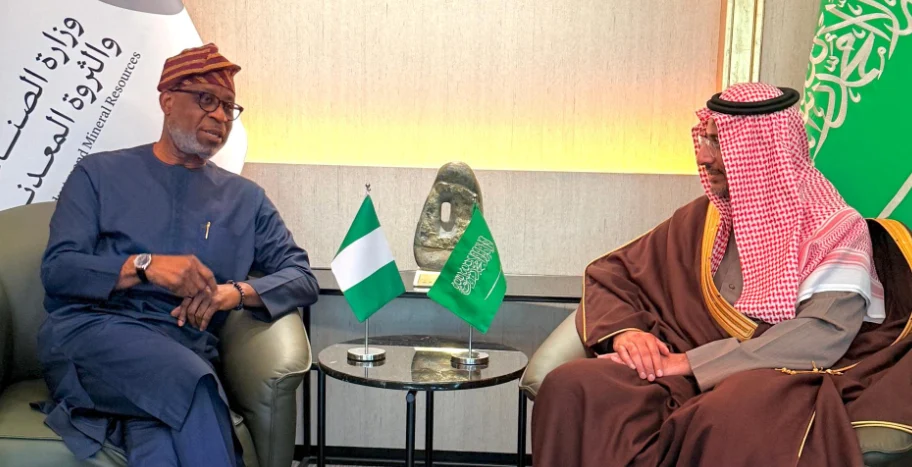
The announcements were made on Tuesday, January 13, 2026, by the Minister of Solid Minerals Development, Dr. Dele Alake, during a meeting with Saudi Arabia’s Minister of Industry and Mineral Resources, Ibrahim Al-Khorayef, ahead of the Future Minerals Forum (FMF) in Riyadh, Saudi Arabia.
Alake described the plants as “tangible outcomes” of policy reforms designed to move Nigeria away from raw mineral exports toward in-country processing and beneficiation.
According to a statement by the minister’s Special Assistant on Media, Segun Tomori, the Lagos plant is operational, and three additional gold refineries are at various stages of development across the country.
The lithium facility in Nasarawa, valued at $600 million, is at the final stages and is set to enhance Nigeria’s capacity to process lithium, a critical mineral for green energy technologies such as electric vehicle batteries and renewable storage systems.
Dr. Alake said the projects reflect the government’s commitment to unlocking the economic potential of Nigeria’s vast mineral resources and attracting foreign partnerships that support technology transfer, capacity building and exploration in the sector.
He noted that a joint working group with the Saudi Chamber of Commerce is poised to present a progress report before the end of the forum, emphasising collaboration on mineral traceability, environmental, social and governance (ESG) standards, and mine-pit remediation.
In his remarks, Minister Al-Khorayef reaffirmed Nigeria’s longstanding bilateral relationship with Saudi Arabia and endorsed actionable agreements to accelerate development in the solid minerals sector.
He encouraged Nigeria and other African nations to showcase investment opportunities and adopt advanced mining technologies at the Future Minerals Forum, a platform for global partnerships in critical minerals.
The government’s emphasis on local processing is aligned with broader mining sector reforms that have drawn significant investment in recent years, including projects totalling hundreds of millions of dollars in processing capacity.
These reforms are designed to boost revenue, create jobs and enhance Nigeria’s role in supplying minerals essential for the global energy transition.
The combination of operational and near-commissioning facilities in gold and lithium positions Nigeria to tap into growing global demand for refined minerals and value-added products, while also supporting economic diversification efforts beyond oil and gas.
Stakeholders in the mining industry say sustained investment, regulatory clarity and international cooperation will be crucial for realising the full potential of Nigeria’s mineral wealth amid rising interest in clean energy materials and strategic resources.